
For risks and side effects consult your librarian
 Scarcely noticed by the scientific community in Germany, an astounding development is taking place: The alliance of German scientific organizations with the Conference of University Rectors (DEAL Consortium) is flexing its muscles at the publishing houses. We are witnessing the beginning of the end of the business model current in scientific publishing: an exodus out of institutional library subscriptions to journals and into open access to all to scientific literature (OA), financed by a once-only article publishing charge (APC). The motive for this move is convincing: Knowledge financed by society must be freely accessible to society, and the costs for accessing scientific publications have risen immensely, increasing every year by over 5% and all but devouring the last resources of the universities.
The big publishing houses are merrily pocketing fantastic returns for research that is financed by taxes and produced, curated, formatted, and peer reviewed by us. These returns run at a fulsome 20 – to 40%, which would probably not be legal in any other area of business. At the bottom of this whole thing is a bizarre swap: With our tax money we are buying back our own product – scientific knowledge in manuscript form — after having handed it over up front to the publishers. It gets even wilder: The publishing houses give us back our product on loan only, with limited access, without any rights over the articles. The taxpayer, having paid for it all, cannot access it, meaning that not only Joe Blow the taxpayer is left standing in the cold, but with him practicing medical doctors or clinicians, and scientists outside of the Universities. Continue reading
 Have you ever wondered what percentage of your scientific hypotheses are actually correct? I do not mean the rate of statistically significant results you get when you dive into new experiments. I mean rather the rate of the hypotheses that were confirmed by others, or that postulated a drug that was in fact effective in other labs or even patients. Nowadays, unfortunately, only very few studies are independently repeated (more on that later) and even therapies long established are often withdrawn from the market as ineffective or even harmful. You can only hope to approach a rate of “success”, and that is exactly what I will now attempt to do. You are wondering why I am posing this apparently esoteric question: It is because knowing approximately how high the percentage of hypotheses is that actually prove to be correct would have wide-reaching consequences for evaluating research results for your own results, and for those of others. This question has an astonishing but direct relevance in the discussion relating the current crisis in biomedical science. Indeed, a ghost is haunting biomedical research!
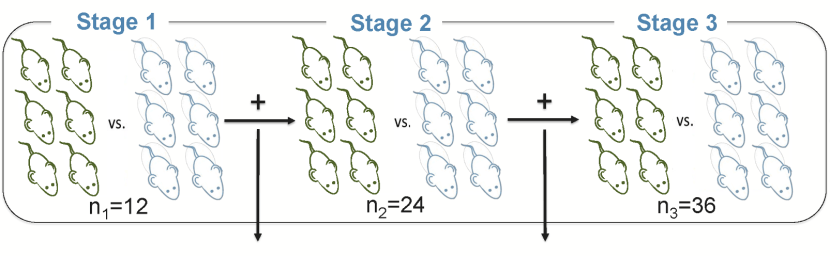 Despite the potential benefits of sequential designs, studies evaluating treatments or experimental manipulations in preclinical experimental biomedicine almost exclusively use classical block designs. The aim of our recent
  The negotiation of a new German-wide arrangement with Elsevier and other publishers for online access to journals has stalled, as Elsevier did not agree to the terms proposed by a consortium of
  … is the title of a


 To infinity, and beyond!